Why Physical Verification Matters as Digital Design Becomes More Abundant
Digital and AI-assisted tools make it easier to generate, visualize, and revise designs. This creates more possibilities, but more options do not necessarily make the right decision clearer.
Before a design moves into approval, fabrication, construction, or production, teams still need to understand what it means in physical space. A physical model gives them something tangible to examine together.
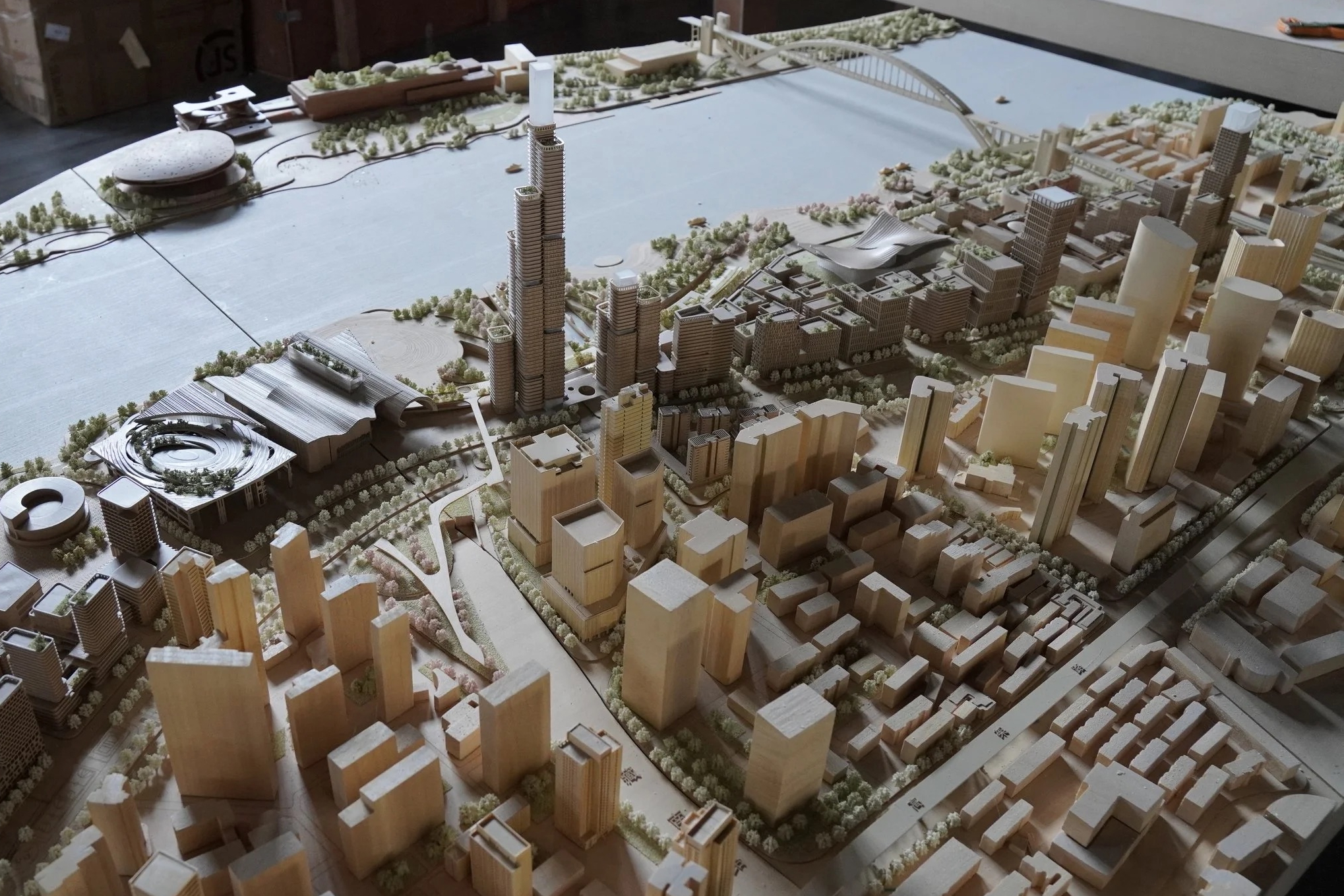 Waterfront Urban Design · 1:750 · Wood
An image is not a complete physical definition
A rendering or AI-generated image can communicate form, materials, atmosphere, and visual intent. However, it may not clearly define:
- Exact scale and proportion
- Relationships outside the selected view
- Circulation and site context
- Components and connections
- Assembly, transportation, or installation
- Whether the geometry works from every viewpoint
A convincing image can therefore be a useful starting point without being a fully resolved physical design.
What does physical verification help clarify?
Depending on the project, a physical model, sample, or mockup can help a team evaluate:
- Form, massing, and proportion
- Site and spatial relationships
- Materials, colors, and finishes
- Components and assembly
- Lighting or functional features
- Handling and installation
- How clearly an audience understands the design
The model should be built around the question it needs to answer. A massing model, presentation model, material sample, and functional prototype provide different kinds of evidence.
A shared reference for different audiences
Architects, developers, contractors, investors, approval agencies, buyers, and community members do not all interpret drawings or digital models in the same way.
A physical model gives them a shared reference. People can move around it, point to the same relationships, compare options, and discuss specific concerns without using specialist software.
The right evidence—not the most detail
Physical verification does not require every detail to be reproduced.
A planning model may emphasize height, setbacks, circulation, and context. A sales-gallery model may require developed façades, landscaping, lighting, and finishes. A product prototype may focus on form, assembly, or function.
The appropriate detail depends on what the audience needs to understand or decide.
Digital and physical tools work together
Physical models do not replace drawings, BIM, renderings, or AI-generated references. They translate selected design information into a form that can be examined in real space.
The process can be understood as:
From possibility to evidence
As design becomes easier to generate, evaluating and communicating the right option becomes more important.
A physical model turns selected design information into tangible evidence. It helps teams identify questions, build shared understanding, and move forward with greater confidence.
About this guide
This guide was prepared by the Carve Model team using our experience defining, coordinating, fabricating, reviewing, packaging, and delivering physical models. Project requirements vary, so recommendations are confirmed during the review of each project.